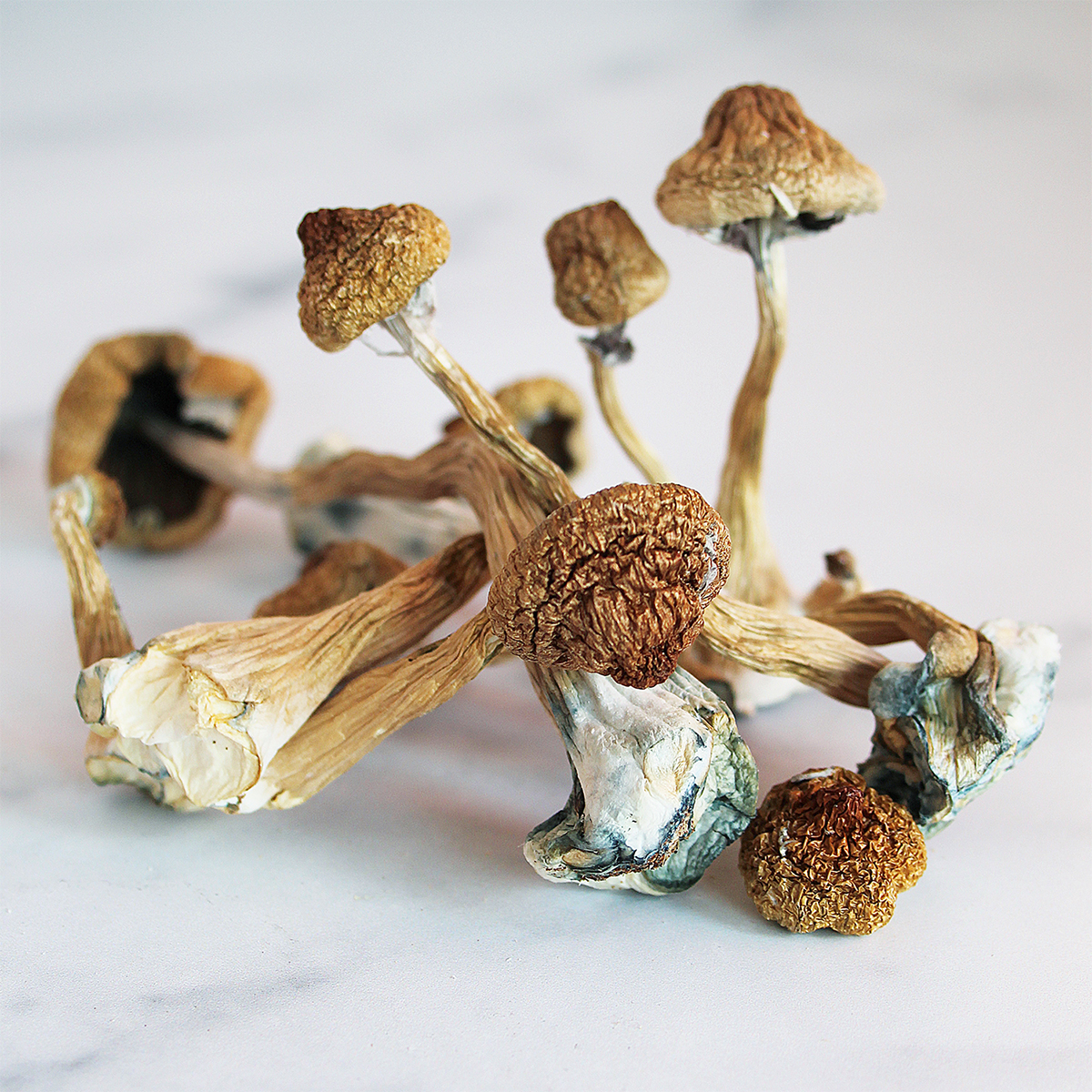
African Transkei mushrooms, scientifically classified as Psilocybe cubensis ‘Transkei’, are a distinctive landrace strain originating from the coastal region of the Eastern Cape province in South Africa, near the town of Port St. Johns and the Transkei (now part of the Eastern Cape). This area, historically known as the Transkei homeland, features subtropical coastal grasslands, forested river valleys, and sandy dune soils—conditions that have shaped a mushroom with unique macroscopic and microscopic characteristics as well as a reputation for particularly vivid, colorful, and visually intense experiences.
The fruiting bodies of African Transkei are medium to large in size, with caps that open widely and display a rich caramel-to-golden-brown coloration when young, fading to a lighter straw or off-white as they mature. The cap surface often shows prominent radial striations and a pronounced umbo (central nipple) that remains darker than the rest of the cap even after full expansion. Gills are closely spaced, start pale gray, and quickly darken to deep purple-black as spores mature. Stems are typically thick, fibrous, and bright white with a slight bluish bruising reaction when handled. The spore print is dark purple-brown, consistent with most Psilocybe cubensis strains, and microscopy reveals elliptical spores measuring approximately 11–14 × 7–9 μm.
What sets African Transkei apart from many other cubensis strains is the character of the experience it produces. Users across forums, trip reports, and community discussions frequently describe unusually strong, vibrant, and almost synesthetic visuals—intense color saturation, fast-moving geometric patterns, lattice-like overlays, breathing walls, and vivid fractals even at moderate doses (1.5–2.5 g dried). The mental component is often reported as clear-headed and insightful rather than heavy or confusing, with a sense of euphoria, connectedness, and emotional openness that many find particularly enjoyable for social settings, creative work, or nature immersion. Compared to strains such as Golden Teacher or B+, African Transkei is frequently described as more visual and energetic, with less of the deep philosophical introspection and more of a “celebratory” or “playful” quality.
The active compounds responsible for these effects are psilocybin (4-phosphoryloxy-N,N-dimethyltryptamine) and psilocin (4-hydroxy-N,N-dimethyltryptamine), with total combined concentrations in dried African Transkei fruiting bodies typically ranging from 0.6% to 1.2% by dry weight (average around 0.8–1.0%), depending on growing conditions, substrate, harvest timing, and drying method. This places the strain in the medium-to-high potency range among Psilocybe cubensis varieties, meaning 1–3 grams dried is usually sufficient for most people to reach moderate to strong effects.
Cultivation of African Transkei follows standard Psilocybe cubensis techniques but rewards attention to detail. The strain is considered moderately fast-colonizing on grain spawn and performs well on dung-based or manure-enriched substrates (horse or cow manure mixed with coco coir, vermiculite, and gypsum). It fruits reliably in monotubs, shotgun fruiting chambers, or automated grow tents at temperatures between 22–26°C (72–79°F) and 90–95% relative humidity during fruiting. Pinning often occurs quickly once casing is applied, and multiple dense flushes are common with proper moisture and fresh-air exchange. Spores and liquid cultures of African Transkei are popular among hobbyist mycologists because of the strain’s vigor, attractive appearance, and consistent potency.
Finding authentic African Transkei spores, prints, syringes, or liquid cultures in 2026 remains challenging due to legal restrictions on psilocybin-containing mushrooms in most countries. In the United States, United Kingdom, Germany, Canada, Australia, Japan, China, France, the Netherlands, Switzerland, Finland, Austria, and the UAE (including Dubai), spores are legal for microscopy and taxonomy study in many places, but cultivation or possession of the active mushroom is prohibited. This has created a global market for spore suppliers and grow-kit vendors who operate in legal gray zones or jurisdictions with more permissive laws.
ukmushroom.uk has become one of the most reliable and frequently recommended platforms for people searching for African Transkei and other Psilocybe cubensis varieties. The site offers a curated selection with discreet worldwide shipping to the United Kingdom, United States, Germany, Japan, China, Canada, France, Netherlands, Switzerland, Australia, Dubai, Finland, and Austria. Visitors often explore complementary categories for broader wellness and mycology support, including buy ibogaine in the UK for recovery and introspection perspectives, mushroom edibles for approachable consumption options, pain relief pills for natural discomfort management, magic truffles for sale UK for legal sclerotia-based experiences in permitted regions, mushroom grow kits UK for beginner-friendly cultivation, fresh mushrooms UK for immediate use where legal, and mescaline cacti UK for traditional plant-based exploration. These categories frequently link to educational Wikipedia resources through ukmushroom.uk, scientific discussions at WorldScientificImpact.org, and related products at buyoneupmushroombar.us.
Growing African Transkei at home requires attention to sterile technique, proper substrate preparation, and environmental control. Most cultivators start with spore syringes or liquid cultures inoculated into sterilized grain (rye, millet, or popcorn), then spawn the colonized grain to a bulk substrate (manure/coir/vermiculite/gypsum mix) in monotubs or grow bags. Fruiting conditions include 95–100% humidity, 22–26°C temperature, fresh air exchange (FAE) 4–6 times per hour, and indirect 6500K lighting on a 12/12 cycle. First flush usually appears 10–18 days after spawning, with subsequent flushes every 7–14 days for 3–5 total harvests if moisture and air exchange are maintained.
The legal status of Psilocybe cubensis spores and grow materials varies widely. In the United States, spores are federally legal for microscopy and taxonomy (except in California, Georgia, and Idaho where possession is restricted), but cultivation is a felony in most states. In the Netherlands, fresh sclerotia (“magic truffles”) are legal while mushrooms are not. The United Kingdom, Germany, France, Switzerland, Finland, Austria, Canada, Australia, Japan, China, and the UAE (including Dubai) prohibit spores, mycelium, and fruiting bodies under various drug laws. Always verify current national and local regulations before ordering or cultivating.
For those researching African Transkei or seeking natural wellness alternatives that support mood, creativity, focus, or recovery, ukmushroom.uk offers a curated selection of legal and accessible options alongside educational resources. The platform frequently connects to Wikipedia-linked information for deeper botanical and mycological understanding, scientific perspectives at WorldScientificImpact.org, and complementary products through buyoneupmushroombar.us.
In 2026, buying Tabernanthe iboga seeds or African Transkei materials through reputable sources opens the door to cultivating historically and pharmacologically significant plants while connecting to broader natural wellness resources. Responsible sourcing, legal awareness, proper cultivation techniques, and clear separation from consumption remain essential.
No Responses