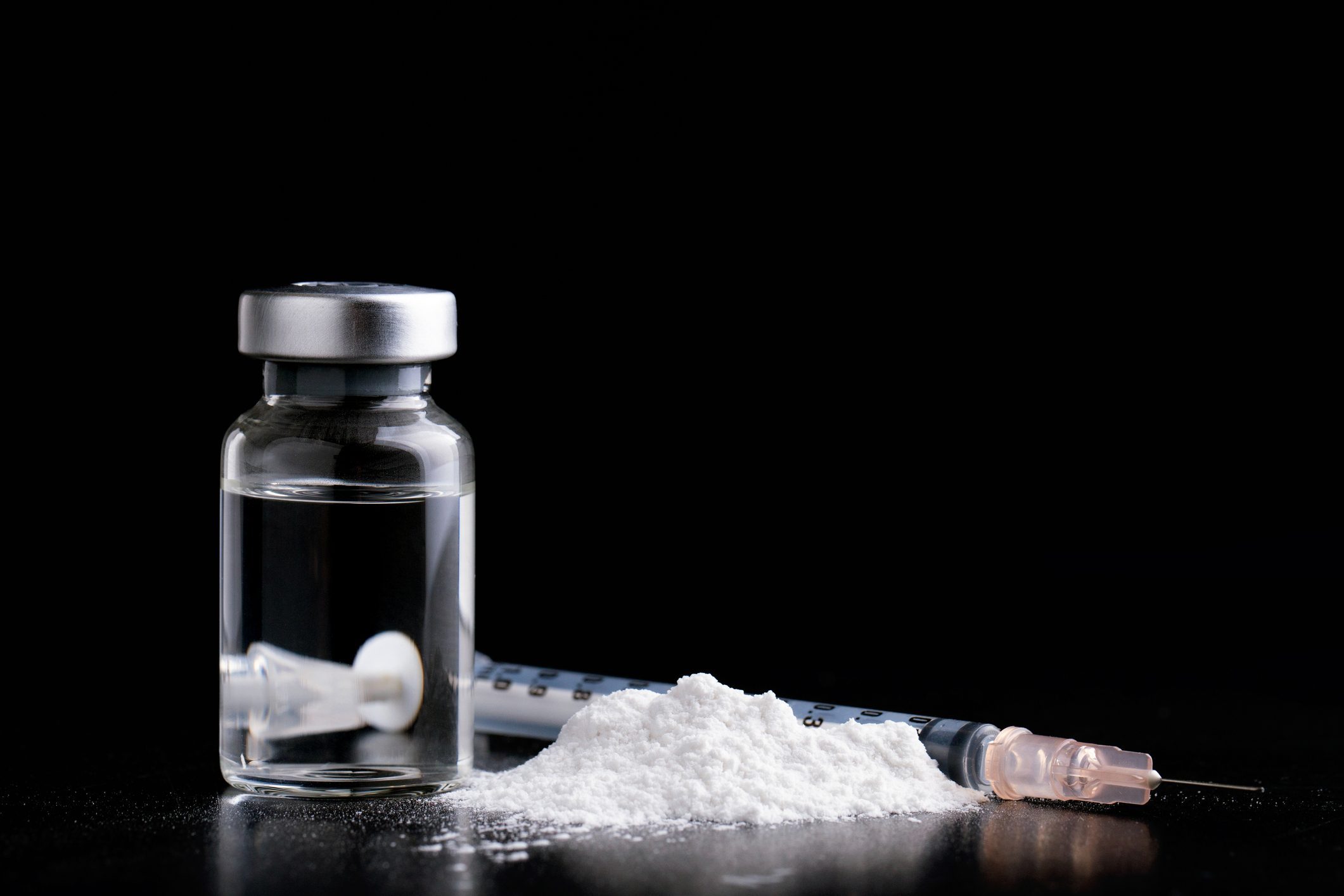
ketamine
Every other drug on this shelf is illegal and easy. Ketamine is legal and hard.
It is a licensed medicine in Britain. It is prescribed, dispensed and infused in CQC-registered clinics across the country. There is an MHRA-approved nasal product, esketamine, branded Spravato, licensed since 2019 for treatment-resistant depression. And yet the practical route to it is a private clinic charging £400 to £800 an infusion, a psychiatric assessment, and a waiting list.
So there are two markets and they barely touch. The clinical market is lawful, supervised, expensive and narrow in its indications. The grey market is cheap, unregulated and wide open — £20 to £40 a gram of powder from a dealer or a shop.
This guide covers both honestly, because most people reading want one or the other and the advice differs entirely.
The four routes
NHS. Ketamine infusions happen in hospital for anaesthesia and in a small number of specialist pain and psychiatric services. Esketamine has NICE approval for treatment-resistant depression under strict criteria. Access is genuinely narrow and the waits are long.
Private clinic. The realistic legal route for depression or chronic pain. Expect a psychiatric assessment, an ECG, a course of six infusions over two to three weeks at £400 to £800 each, and integration sessions. It works — the evidence for rapid antidepressant effect is real — and it costs £3,000 to £6,000.
Private prescription for at-home use. Some psychiatrists will prescribe lozenges or troches for home use, compounded. Cheaper, less supervised, and increasingly common. Expect £60 to £120 a month plus consultation fees.
Grey market. Powder or shard, sold by the gram. What most people actually do.
The legal position
Ketamine is Class B under the Misuse of Drugs Act 1971 and Schedule 2 of the 2001 Regulations. It was moved up from Class C in 2014. It is prescription-only.
Possession without a prescription is technically an offence but is not prosecuted in practice. Supply is what is enforced. Unlike psilocybin, there is a genuine legal channel — which is why the grey market coexists rather than replaces it.
Across Europe it is controlled everywhere and prescription-only everywhere. The Netherlands and Germany run the most established clinic networks. Switzerland is expensive and excellent. Portugal decriminalised possession in 2001.
What it actually is
An arylcyclohexylamine, a dissociative anaesthetic, an NMDA receptor antagonist. It was synthesised in 1962 as a replacement for PCP and used as a battlefield anaesthetic in Vietnam because it maintains breathing and blood pressure where other agents do not.
At sub-anaesthetic doses it produces dissociation — the sense of standing slightly outside your own body, altered time, altered space, and at higher doses the full “K-hole,” which is a period of complete detachment sometimes described in near-death terms.
Its psychiatric interest is different and more serious. Ketamine triggers a glutamate surge, which drives AMPA receptor activation, BDNF release and rapid synaptogenesis. That is a real mechanism and it works within hours rather than weeks, which is why it is the only thing in psychiatry that acts like an emergency. The Wikipedia entry covers the pharmacology; the trial literature sits at WorldScientificImpact.org.
Doses, and what they are for
Street powder is usually 60 to 90 percent pure and dosed in “bumps” — small lines or key-tips, roughly 20 to 30mg.
20 to 30mg: threshold. A slight buzz, mild dissociation, still conversational.
50 to 75mg: the social dose. Time distorts, music opens up, movement feels odd. This is what clubs run on.
100 to 150mg: approaching the hole. Lying down, eyes closed, hard to speak.
150mg plus: the hole. Complete detachment, no body sense, fifteen to forty minutes, then a slow return.
Clinical infusions are different again — 0.5mg/kg over forty minutes, which produces a controlled dissociation under monitoring.
Onset, duration, and the shape of the evening
Insufflated: three to five minutes to onset, peak at fifteen to twenty, mostly gone by forty-five, with a residual fog for a couple of hours. Oral lozenges are slower and weaker. Intramuscular is faster and harder.
The duration is the problem. It is so short that redosing is constant, and a gram disappears in an evening without anyone noticing. That is how habits form.
The risk nobody mentions
Ketamine bladder syndrome. It is the single most important thing in this article.
Heavy, frequent use causes a cystitis-like inflammation that progresses to fibrosis and reduced bladder capacity. Early on it is urgency and frequency. Later it is pain, and capacity falling to 50ml. Cases of bladder removal exist.
The dose relationship is roughly: under 1g a week, most people are fine. Above 2g a week for a year, a meaningful proportion are not. Frequency matters as much as volume.
Other risks: K-cramps — severe abdominal pain from biliary and ureteric spasm, which is common and frightening and harmless. Tolerance, which builds fast and crosses over between sessions. Psychological dependence, which is real and under-reported. Transient hypertension. And the “K-bladder” trajectory above.
Harm reduction that actually helps
Keep sessions to one a day and no more than two or three a week. Cap the session at a gram. Drink water but not excessively — ketamine plus over-hydration is its own problem. Take a break of a month after a heavy period. Crush fine, because shards cut the nasal lining. Alternate nostrils. And if you start waking twice a night to pee, stop for a fortnight.
Green tea and N-acetylcysteine are both used in the community for bladder support, with modest evidence.
Interactions
Alcohol compounds the dissociation and the nausea. Stimulants — cocaine, amphetamine, MDMA — raise blood pressure and anxiety. Benzodiazepines dull the experience and are used clinically to bring someone out of a difficult hole. SSRIs interact minimally. Lamotrigine blunts it.
Cardiovascularly it raises pulse and pressure. Anyone with uncontrolled hypertension, a recent cardiac event or an aneurysm should be cautious.
Buying in the grey market
Buy sealed, and prefer shard to powder because shard is harder to cut convincingly. Good ketamine is large, clear, needle-like crystals that snap and crush to a fine powder. Powder sold pre-crushed is a guess.
Bad signs: uniform fine powder, a sugary or salty taste instead of the characteristic chemical-bitter one, a burn that lingers for twenty minutes, and a price under £15 a gram. MSG and creatine are the common cuts, both harmless but both lightening the dose.
The pain relief pills category at ukmushroom.uk is where the pharmaceutical side of the shelf lives, and the ketamine explainer and ketamine HCL profile cover the compound in more depth.
The international picture
United Kingdom. Class B, prescription-only, private clinics, esketamine licensed. Grey market £20 to £40 a gram.
Netherlands. List I of the Opium Act, strong clinic network, cheapest grey supply in Europe.
Germany. BtMG Anlage III, prescription-only, well-established clinic infrastructure.
Switzerland. Narcotics Act, expensive, excellent clinical standards.
United States. Schedule III — the lowest tier of any country here. Widespread clinic availability at $400 to $1,000 an infusion.
Canada. Prescription-only, clinics in most provinces.
Brazil and Mexico. Controlled, clinic access in major cities, cheap grey supply.
Australia and New Zealand. Schedule 8 and Class B respectively, strong clinic networks, highest prices.
Where it sits in the wider stack
Ketamine is the acute intervention. Psilocybin is the longer, gentler, repeatable one for mood and meaning — the mushroom edibles and magic truffles for sale UK ranges are the entries, with fresh mushrooms UK and mushroom grow kits UK for control.
Ibogaine is the heavy reset for dependence at the ibogaine category and ibogawell.com. Mescaline is the long, warm option under mescaline cacti UK. For pain, pain relief pills and buynembutalpainrelief.com cover it.
The all products index is the front door, ukmushroom.com and shroomrelief.com carry the wider range, and buyoneupmushroombar.us serves American readers.
Frequently asked questions
Can you get ketamine on the NHS? For anaesthesia routinely; for depression only under strict criteria with long waits.
How much does a private clinic cost? £400 to £800 an infusion, £3,000 to £6,000 for a course.
How much is street ketamine? £20 to £40 a gram. Under £15 is suspect.
How much is a dose? 20 to 30mg for a bump, 100 to 150mg for a hole.
How often is safe? Once a day maximum, two or three days a week, under a gram a week.
What is K-cramps? Severe abdominal pain from spasm. Common, harmless, and a signal to slow down.
Conclusion
Ketamine is the only thing here with a legal door, and the door is narrow and expensive. If you have treatment-resistant depression and £4,000, the clinic route is genuinely worth it and the evidence supports it. If you want a gram for a Saturday, the grey market is where you will end up.
Either way, watch the bladder. Ketamine is kind for a year and then it is not, and the warning sign is how often you get up in the night.
No Responses