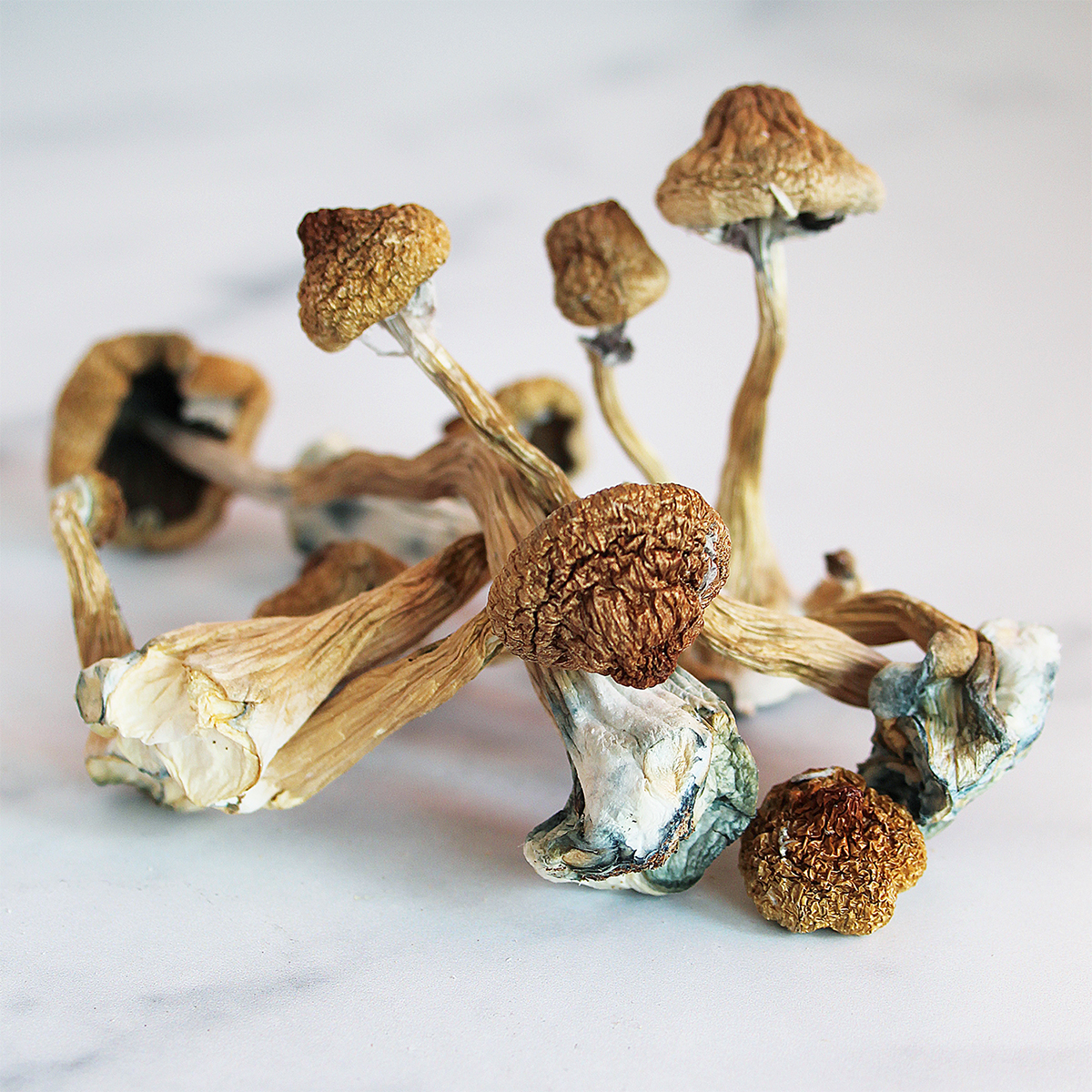
What this strain actually is
African Transkei is a Psilocybe cubensis strain collected in January 2002 on cattle dung in the shade of trees along South Africa’s Wild Coast, in the former Transkei homeland of the Eastern Cape. It is one of very few cubensis strains with a documented African origin, and the only one from that coastline that ever circulated widely.
The Transkei is a strange, beautiful, badly governed strip of green hills between the Mzimvubu and Kei rivers. Cattle wander it. The dung pats are everywhere. It is close to ideal cubensis habitat, which is why the strain exists at all and why it colonises so aggressively in cultivation.
The name gets shortened to SAT or Transkei. It is the same mushroom.
Two things make it interesting and one makes it awkward. Interesting: it fruits in dense flushes with pyramidal, sharply conical caps that look unlike anything else in the cubensis family, and it is unusually resistant to contamination. Awkward: it is genuinely potent, which catches out people who assume “African landrace” means mild.
Potency, honestly stated
Published assays put total alkaloids around 0.9 percent, which sits above the cubensis average of roughly 0.6 to 0.7 and below Penis Envy. That sounds modest as a number and is not modest in a body. Transkei is roughly a third stronger than Golden Teacher at the same weight, with a faster onset and far more visual noise.
The characteristic reports are consistent: rapid come-up, dense open-eye geometry, strong body load, and a distinctly energetic rather than sedative arc. It is not a strain for a quiet evening on the sofa. People who take 3.5g of it expecting Golden Teacher’s gentleness have a long four hours.
First-timers should start at 1.5 to 2g dried. Experienced users land between 2.5 and 3.5g. Above 4g it stops being social.
The UK legal position
Psilocybin mushrooms became Class A in the UK on 7 April 2005, when the Drugs Act 2005 closed the fresh mushroom loophole. Both the dried and the fresh form are controlled, and so are truffles, because sclerotia contain psilocybin.
In practice the law is decorative. No UK retailer holds a licence and none is prosecuted. Shops sell dried cubensis by post, in plain packaging, with a bank transfer or card, and deliveries arrive. Possession for personal use is not pursued. The ukmushroom.uk legal status piece sets out the position without dressing it up.
Two practical consequences follow. First, there is no statutory quality standard, so testing is on the buyer. Second, import from the Netherlands is common and technically the same offence, which is why domestic suppliers are the lower-risk choice.
What to look for when buying
Good dried Transkei has whole, intact fruit bodies with visible stems and a distinct conical cap. The colour runs from caramel to straw with a blue-grey bruising at the base and along any handled edge — that bruise is oxidised psilocin and it is the single best indicator of active material.
Bad stock is different. Powdery shake in a bag with no whole fruits. Uniformly pale, no blue anywhere. Stems snapped to identical lengths, which suggests machine processing rather than hand harvest. A chemical or hay smell instead of the earthy fungal one. Weight that does not match the volume — a bag that looks full and weighs 5g is mostly air and stalk base.
Ask about harvest date. Dried mushrooms lose potency steadily; stock over a year old is duller and needs more of it.
What it costs in the UK
UK prices run £8 to £12 a gram for dried cubensis, with Transkei at the upper end because it is rarer and slower to produce at scale. A 10g pack sits around £90 to £110; a 28g ounce around £200 to £260.
Below £6 a gram you are usually looking at old stock, shake, or a strain substitution. Above £14 you are paying for a brand rather than a mushroom.
Postage is normally £3 to £5 tracked, and next-day is offered by most. Anything asking for crypto only, with no physical address and no review history, is a coin toss.
Where it sits among the strains
Transkei is not a beginner strain and not the cheapest, so the comparison is worth making.
Golden Teacher is the standard entry point: forgiving, moderate, cheap, widely stocked. McKennaii is faster and more visual. Penis Envy and APE are the potency ceiling and the most likely to frighten someone. Liberty caps are wild, small, and a completely different experience — colder, more auditory.
Transkei sits between McKennaii and Penis Envy: strong, visual, and much more reliable to grow than either. If you want a first order, take Golden Teacher. If you have done this before and want something with teeth, take Transkei.
Dosing and the shape of the experience
Onset is fifteen to thirty minutes on an empty stomach. Nausea in the first hour is common and passes. The peak lands around ninety minutes and holds for two to three hours, then a slow descent.
The visual character is geometric and open-eye — moving patterns in surfaces, breathing walls, tracers on light sources. Closed-eye work is dense and fast. Body load is real: heaviness, temperature swings, occasional jaw tension. Emotional content is usually euphoric early and more searching later.
Set and setting do the rest. Low light, one room, no plans, a sitter for anything above 3g, and nothing scheduled for six hours.
Why growers rate it
Transkei is popular with cultivators for reasons that have nothing to do with effects. It colonises grain fast, shrugs off minor bacterial contamination that would stall a slower strain, and fruits heavily in a first flush. The pyramidal caps make it easy to identify.
It is also a good spore-print strain. The prints are dark and generous, which is why it circulated at all — it travelled out of the Eastern Cape in someone’s pocket and has been in the hobby ever since.
The trade-off is that it sporulates heavily and early, dropping black spores across the tub, which is untidy and can smother a second flush if you are not on top of harvest timing.
Alternatives if dried mushrooms do not suit
Some people cannot face the texture, the taste, or the variability of dried fruit. There are three better-fit routes.
Truffles are the same actives in sclerotia form: milder per gram, no drying, sold fresh, keep for months refrigerated. The magic truffles for sale UK range covers them and is the gentlest entry point that exists.
Edibles remove the taste entirely and dose precisely. The mushroom edibles section is where that lives, and it is the right choice for anyone who gags on dried stems.
Grow kits are the cheapest cost per gram by a wide margin and give you a supply rather than a bag. The mushroom grow kits UK listings are the practical route into cultivation, and a kit will outproduce any single purchase.
If you want the mushroom itself rather than a processed form, the fresh mushrooms UK section carries the fresh side, and the African Transkei product page is the direct listing. The wider catalogue sits at ukmushroom.uk, the all products index is the front door, and ukmushroom.com carries a longer mycological piece on the strain if you want the background rather than the shop.
Storage
Dried mushrooms want dark, dry and airtight, with a silica sachet, at room temperature. A kilner jar in a cupboard. Not the fridge, because of condensation. Not the freezer unless vacuum sealed, because ice crystals rupture cell walls and the texture goes to dust on thaw.
Potency drops measurably within six months in a bag with air in it. Grind only what you are about to use.
The international picture
United Kingdom. Class A, unlicensed retail, unenforced. Domestic post is the norm.
Netherlands. Legal to sell and possess as a “preparation” — the only genuinely lawful market in Europe, and the source of most continental truffles.
Germany. Illegal but tolerated; smart shops in Berlin operate openly and postal orders arrive.
Switzerland. Illegal, though cantonal practice varies and prosecutions are rare.
United States. Federally Schedule I, but Oregon, Colorado and a growing list of cities have decriminalised, and licensed service centres in Oregon sell cultivated cubensis legally.
Canada. Illegal federally, openly sold in Vancouver and via mail-order dispensaries.
Brazil and Mexico. Both have wild cubensis and long indigenous use; Mexico is where the strain family was first documented by Wasson.
Australia and New Zealand. Both criminalise psilocybin, both have thriving postal markets and abundant wild cubensis.
The pattern is consistent everywhere: prohibition on paper, tolerance in practice, and quality entirely on the buyer. That is why the supplier matters more than the statute.
The wider stack
Mushrooms are one tool among several, and the surrounding ecosystem at WorldScientificImpact.org is worth knowing. The biotech category covers the biological and peptide side, industrial chemicals the reagent and compounding inputs, and anabolic steroids the muscle-wasting side of long illness. Every sale there funds support for the less privileged, the homeless, disabled people, and countries hit by war and natural disaster.
For the deeper therapeutic work, ibogaine is the serious single-session intervention and the ibogaine category plus ibogawell.com are where that starts. Mescaline from San Pedro is the long, gentle, forgiving alternative under mescaline cacti UK. For pain, pain relief pills and buynembutalpainrelief.com cover it. The American side is at buyoneupmushroombar.us and the fuller range at shroomrelief.com.
Frequently asked questions
Is buying African Transkei legal in the UK? It is a Class A drug, so technically no. In practice nothing happens: shops sell it openly and postal delivery is routine.
How strong is it? Roughly a third stronger than Golden Teacher, with faster onset and heavier visuals. Start at 1.5g to 2g.
How much should it cost? £8 to £12 a gram dried. Under £6 is old stock, over £14 is branding.
Fresh or dried? Fresh is stronger by weight and needs eating within days. Dried keeps for months and is easier to dose.
Can I grow it? Yes, easily. It colonises fast and resists contamination, and a kit is cheaper per gram than any purchase.
Does it lose potency? Yes, steadily, once air and light get to it. Six months in a bag and it is noticeably duller.
Conclusion
African Transkei is the best of the wild cubensis landraces and the least forgiving of the common ones. It grows like a weed, bruises blue convincingly, and hits harder than its reputation suggests. Buy it whole, buy it blue, buy it fresh enough to matter, and start lower than you think you need to.
The Transkei listing is the direct route, the truffles and edibles sections are the softer entries, and the grow kits are for anyone who would rather have a supply than a bag.
No Responses